New website ready… but no visitors? That’s a common problem for mobile valeting businesses.
No need to worry — in this guide, I’ll show you 7 proven ways to drive traffic to your mobile valeting website.
As a digital marketer with over 15 years of experience, I can confidently say the following strategies consistently deliver results — even if you don’t have a big budget or experience.
Let’s jump straight in.
1. Get social (media, that is)
Social media is one of the most powerful tools for driving free traffic to your mobile valeting website. Billions of people — more than 65% of the world’s population — use social media.

In the UK alone, 50 million people are active on social media, with many using it to find businesses and services. If you’re not promoting your valeting services on social media, you’re missing out on tons of free traffic and leads.
How to use social media to drive traffic to your website:
Create profiles on all social media platforms
The first step toward social media domination is creating profiles on all the biggest platforms including Facebook, Instagram, TikTok, YouTube, and X (Formerly Twitter).

It only takes a few minutes to sign up and all you need is an email and phone number.
Quick Tip: Make sure you use a working email and a strong password to keep your accounts secure.
Write a compelling bio or description
After setting up your profiles, write a bio that gets straight to business. Include essential keywords like ‘mobile valeting’ or ‘mobile detailing’, list your main service areas and end with a clear call-to-action (CTA) like ‘call now’ or ‘book today’.
Example of a good bio for a mobile valeting business:
”Professional mobile valeting and detailing company covering Leeds, Morley, Pudsey, and Farsley. Prices from £30 for a basic valet. Visit our website or call to book now!”
Many valeters forget to include coverage areas or starting prices in their bios. Since this is the first thing potential customers read on your page, it’s essential to include these important details.
Add additional business details (if possible)
Certain platforms, like Facebook, allow you to add more business details — such as a phone number, email, and opening hours.
Fill in as many sections as possible to make your profile look compete and trustworthy.

Upload a profile image and cover photo
Next step: upload a profile image and cover photo (if the platform allows). For best results, use a real photo of your work, or ideally a picture of you with your van and visible branding.
Avoid using just a logo or generic car images, as this can feel impersonal.
Example of a strong profile with good photos:

Add a website link and connect your pages
Most social platforms let you add a website link to your page, but some have requirements before you can do so.
For example, Facebook lets you add a link right away, whereas TikTok requires you to have 1000 followers.
If you can add a link, do it. If not, work towards meeting the platform’s requirements so you can add it later.
Also, make sure you connect all your pages by linking them to each other. For example, add links to your TikTok, Instagram, and YouTube pages on your Facebook profile.

Quick Tip: When your social profiles are live, add links or buttons to them on your website. This makes it easier for customers to find and follow you.
Post consistently to grow your followers
You’ve set up your profiles, added contact details, and uploaded images. It’s time to start posting content to grow your followers.
Make an effort to post at least a few times a week and stay consistent.
Share photos of your work, testimonials, and updates
For sites like Facebook and X, you can post photos of your work, customer testimonials, limited offers, and availability updates. Another option is to review products or share car cleaning tips and advice.
Example of a great social media post for mobile valeting:

Make videos to reach a bigger audience
Want to reach people fast? Post videos. All you need is a decent camera and a bit of creativity. Film your valets, offer car care tips, or make dramatic before-and-after edits.
A good video can attach thousands of likes and comments:

Simple apps like CapCut make it easy for anyone to create professional videos. You don’t need any experience with video editing and better yet — you can do it all for free.
Video marketing works. Many companies started small and became massive brands just by posting videos.
The proof is in the pudding!!
Take SpudBros as an example. They started with a single van, but quickly grew to millions of followers by posting videos on TikTok.
Now they have multiple franchises with plans to open 30-40 more globally.
Not bad for a little potato business, eh?

And it’s not just spuds either — many mobile valeting companies also have millions of followers and likes.
Fivestar Detailing and Clean Attention To Detail are perfect examples of how social media can be used to rapidly grow a service-based business.

Consistency is the name of the game. You won’t get thousands of followers overnight. It takes time, effort, and a bit of trial and error. But if you stay motivated and keep posting, your audience and engagement will start to snowball.
2. Become Google’s best friend
Search engine optimisation (SEO) is the slow cooker of marketing — it takes time, but the results are delicious.
With a bit of patience and effort, SEO can drive thousands of free visitors to your mobile valeting website — without spending a penny on ads.

What is search engine optimisation?
If you don’t already know, search engine optimisation is the process of improving your website so it ranks higher on Google and other search engines.
As an example, if someone searches for ‘mobile valeter in London‘, the sites at the top of results get huge amounts of free traffic. Google has chosen them as the best options for searchers.

Bute how do you get to the top of Google? That’s where search engine optimisation comes in. There are a few simple but essential steps you can take to help your site rank higher.
How to get more website traffic from Google:
Optimise the homepage of your website
Optimising your website’s homepage is one of the easiest ways to improve your rankings on Google.
The homepage is where most of your visitors will land, so it needs to be fast, well-structured, and SEO-friendly.

Here are the best ways to optimise your homepage:
Add relevant keywords
First off, add relevant keywords like ‘mobile valeting’ and ‘mobile detailing‘ to your homepage content.
Sprinkle them in naturally, without overdoing it. Also, include a clear list of the areas you serve.
At the very least, your main keywords should appear in the header, along with a call-to-action button like ‘book now’ or ‘get a quote’.
Example of a good homepage header:

Improve loading times
Everyone hates a slow website, right? According to a study, 53% of people leave a page if it takes longer than three seconds to load on mobile. That’s a lot of lost customers because of poor performance.
The worst part? Google tracks user behaviour — like how long people stay on your page — to judge relevance. If a lot of your visitors leave quickly, it shows low engagement which can hurt rankings.
Best ways to improve website speed:
- Optimise images and videos to reduce file sizes
- Use a lightweight theme and limited plugins
- Keep widgets and animations to a minimum
- Avoid using sticky headers, sliders, or popups
- Use a content delivery network like Cloudflare
Free tools like Pingdom and GTmetrix let you test your website’s speed and find improvements. In most cases, using too many advanced features like sliders, animations, widgets, and popups makes a website slow.
A fast and lightweight site is better than a slow one with unnecessary extras.

Steamline the layout and menu
Using a clean, modern homepage layout increases engagement, keeps the site fast, and make it easy to use. That, in turn, improves your chances of ranking higher on Google.
Cluttered and hard-to-navigate sites often lose users fast. Your focus should be on making it as easy as possible for visitors to find what they need.
Use simple sections and basic content blocks like images, headings, text, and bullet points. Also, make sure the menu is easy to read and includes links to essential pages like About, Contact, Prices, and Services.
This not only helps visitors to navigate your site but it makes it easy for Google to crawl the content.
Set meta title and description
A meta title and description are basically the the headline and preview text you see in Google results.
Example of a meta title and description:

Google can automatically generate meta titles and descriptions from your page content, but it’s better to write them yourself.
Well-structure meta data can increase click-through rates, which means more people will visit your site.
Ideally, write a unique meta title and description for every page and blog post. At the minimum, do it for the homepage.
The steps to set up meta titles and descriptions depend on your website builder. Most platforms have the feature built in or offer it through an extension or app.

How to create a good meta title and description:
- Keep the title under 60 characters and the description between 150-160 characters.
- Summarise the page clearly and include the main keywords naturally, like ‘mobile valeting in Leeds‘.
- Make each title and description unique — don’t just copy and paste the same content.
- Think outside of the box and try to image what the user is looking for when searching on Google.
Meta title and description template for mobile valeters:
Title – Fresh Wheels: Expert Mobile Valeting Service in Edinburgh
Description – Professional mobile valeting company in Edinburgh with over 10 years of experience. Full valets from just £30 at your home or workplace. Book online today.
Create a blog and publish regular posts
A blog is a must-have for any website that wants to rank on Google. Each blog post has the potential to bring in hundreds, even thousands of monthly website visitors.

The secret is producing enaging, high-quality content that targets a specific group of keywords.
For example, on a mobile valeting website, publishing a blog post titled ‘What’s Included in a Mini Mobile Valet’ is a great way to rank for the keywords ‘mini valet’ and attract targeted visitors.
The best tool for finding high-volume keywords is Google Keyword Planner. It’s free, and it tells you exactly how many people search for specific terms on Google.

After using the keyword planner, I can see that around 1000 people search for ‘mini valet’ in the UK. It’s also a low competition keyword. A high-quality blog post targeting these keywords is likely to rank highly on Google fairly quickly.

This is just one example of many. You can input ‘mobile valeting’ in the keyword planner and discover hundreds of other keywords to target with blog posts. Each post should be optimised for a different set of keywords and offer value to readers.
Blog post ideas for a mobile valeting website:
- What is Mobile Valeting and What Does it Include?
- Why Mobile Valeting is Better Than Car Washes
- How to Prepare Your Car for a Mobile Valet
- What to Expect During a Mobile Valet Service
- The Difference Between Mobile Valeting & Detailing
Set up landing pages for different areas
Another great way to expand your SEO reach is to create seperate pages for each location and service you offer.
For example, if you’re based in London but serve nearby towns, create pages for each location. Your homepage can focus on London, while seperate pages cover other areas like Greenwhich, Croydon, and Sutton.
Do the same for services. Build pages for exterior valets, mini valets, full valets, and specialist services like mould removal, pet hair removal, and machine polishing.
The more pages you have, the more search terms you’ll appear on Google for. You’ll reach customers searching for specific services or locations like ‘mobile valet London’, ‘mobile valet Greenwich’, and so on.
Build high-quality backlinks to your website
Backlinks are one of the biggest ranking factors in SEO. When another website with high-authority links to your website, it shows Google that your website is trusted.
The more backlinks you have, the higher you will rank on Google. It’s really that simple.
How to build powerful backlinks to your site
The best way to build high-quality backlinks is through manual outreach. This means contacting websites related to mobile valeting and asking them if they accept guest posts.
Provide them with a well-written blog post and in return, they will include a link back to your website.
Create a Google Business Profile (Google My Business)
A Google Business Profile is a free service which let’s you set up and manage a listing for your business.
Once you set up a Google Business Profile, your company will start showing up in search and on Google maps, alongside important information about your business such as opening hours, location, and contact details.

A business profile on Google is essential for SEO as it’s another way to help customers find your company. It’s quick and easy to set up and you can add photos, collect reviews, answer questions, and control how your business appears on Google.
Example of a Google Business Profile:

The benefits of a Google Business Profile:
- Increase credibility and visibility on Google
- Collect and respond to customer reviews
- Be found when users search on Google Maps
- Upload photos, videos, and important updates
- Include a link to your website to drive more traffic
3. Run paid ads that actually work
📆 Book a mobile valet in minutes
We'll match you with an approved local valeter — quick and easy.
Want traffic fast? Paid ads are the quickest solution if you have the budget. On average, pay-per-click ads deliver a 200% return on investment for UK businesses. That’s £2 in earnings for every £1 spent.
For well-tuned campaigns, return on investment (ROI) can be as high as 500% or more.
Put simply: paid ads can bring in lots of traffic and bookings for your mobile valeting business.

Best paid ad platforms for mobile valeters:
Google and Facebook are the best platforms for running paid ads. Both use a cost-per-click (CPC) system, meaning you only pay when your ad is clicked. Plus, you get full control over daily budget, targeting options, and keywords.
The benefits of running paid ads:
- Drive targeted traffic quickly
- Only pay for clicks on your ad
- Set a daily budget or spend
- Flexible targeting options
Understanding paid ad types
Google ads are mostly text-based in search results, whereas Facebook ads can include images and more copy. Basically, the ‘sponsored results’ you see on Google search pages are PPC ads.

Getting started with paid ads
Paid ads are easiest when you stick to one platform at first. There’s a learning curve for setting up ads, tracking performance, and optimising conversions — and it can get confusing if you try to do everythig at once.
YouTube is a great place to learn how to run Google or Facebook ads. Watching a video is often easier than following a written guide.
Here’s a few useful videos about running paid ads:
Consider hiring a paid ads expert
If you don’t have time to run ads yourself, consider hiring a Google or Facebook ads expert. They’ll create and manage your campaigns so you get the best possible results.
Most experts charge either a percentage of your ad spend or a fixed monthly fee. While it’s an extra cost, a good ads expert can stop you from wasting money and make your budget go further.
4. Hit the streets with flyers
Flyers might fell old-school, but they still pull their weight. People are 89% more likely to remember getting a flyer than any other form of marketing, and nearly 90% of businesses report positive results from using them.
Flyers work especially well for mobile valeting, as people prefer to support small local businesses over large corporations.
How to get flyers for your mobile valeting business
There are a few ways to get flyers for your mobile valeting business. You can design and print them yourself using platforms like VistaPrint, Instaprint, and Printed, or you can hire a graphic designer to create one for you.

If you decide to a hire a graphic designer, freelance marketplace like Upwork and Fiverr are great options and typically much cheaper than using a design company.
Best options for distributing flyers
For flyer distribution, you can either post them yourself locally or use a flyer distribution service. In the UK, the most popular options are Royal Mail’s Door Drop or Leaftletdrop. Both services offer reliable leaflet distribution for only pennies per household.

5. Put your website link everywhere
If you want people to find your website, don’t be shy with the link. Add it to invoices, flyers, business cards, van signage, email signatures, and social media profiles. The more places it appears, the more clicks you’ll get.

Best places to put your website link:
- Business cards
- Invoices
- Letters
- Emails
- Van signage
- Flyers
- Social profiles
You can also add your link to directories, forums, Facebook groups, and other community-based platforms. Just be sure to follow the rules and avoid spamming — nobody likes that.
6. Build an email list worth emailing
📆 Book a mobile valet in minutes
We'll match you with an approved local valeter — quick and easy.
More than 4 billion people use email — so if you want traffic, email marketing is hard to beat. It also delivers some of the highest conversion rates around, averaging 2.8% compared to under 1% for video marketing.

For a mobile valeting company, building an email list should be a priority. Use a low-cost (or free) email marketing tool to add a subscription form to your site and start collecting emails. Once that’s set up, create automated email campaigns to bring people back to your site.
MailerLite is a great example of a solid email marking software. It’s easy to use, free for up to 500 subscribers, and lets you send 12,000 automated emails per month.
Best free email marketing tools for mobile valeters:
- MailerLite – 500 subscribers | 12,000 emails (Free)
- MailChimp – 250 subscribers | 500 emails (Free)
- Sender – 2500 subscribers | 15,000 emails (Free)
- EmailOctopus – 2500 subscribers | 10,000 emails (Free)

Email marketing campaign ideas for mobile valeters:
- Promote exclusive offers and discounted valets
- Share examples of your work and testimonials
- Ask for feedback about your services or website
- Share tips and tricks about car care and maintenance
7. Get listed in (good) directories
Did you know? Businesses listed in quality directories get around 24% more website visits than those relying on search alone.
Better still, 76% of consumers still use online directories to find local services — especially niche ones like mobile valeting.
The key is to find directories with high-quality and lots of traffic. Ideally, you want platforms that offer a free listing with a website link. Not only does this boost visitors, but it also helps your SEO rankings.
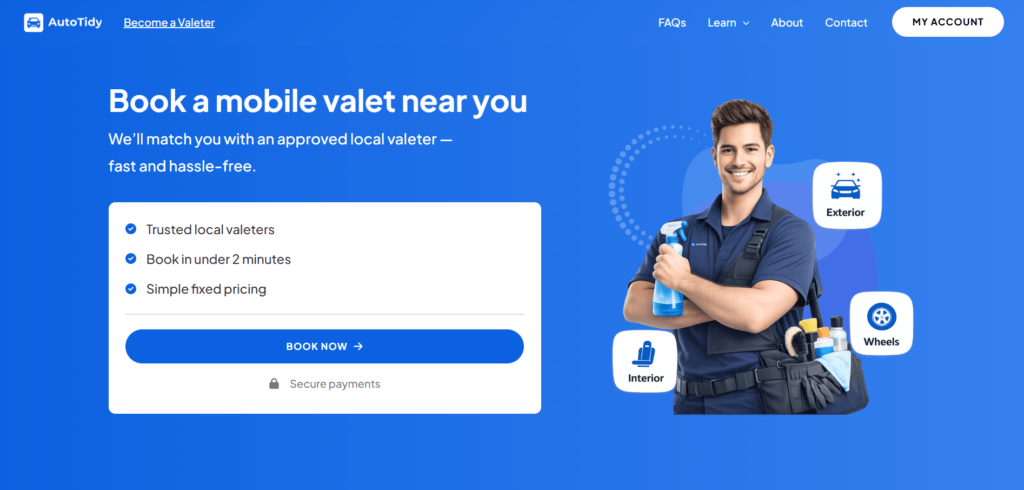
Best free business directories for mobile valeters:
- AutoTidy
- Yell
- Yelp
- Thomson Local
- Bizify
- Local Pages
- We Get You Found
- FreeIndex
- UK Business List
- Business Directory
Heads up — all of the directories above offer free listings, but some may charge for additional features like a website link. Check with the directory before creating a listing.
Best paid directories for mobile valeters:
- Checkatrade
- Bark
- UK Business Portal
- Trustatrader
Quick Tip: Don’t pay to list your business in a directory without doing your homework. Make sure the directory gets plenty of traffic and is relevant to the mobile valeting market.
Conclusion
These days, just having a website for your mobile valeting business isn’t enough. You need smart digital marketing to bring in traffic, increase domain authority, and build trust with search engines.
Take it from someone with over 10 years of marketing experience, the strategies in this guide are proven ways to get more visitors to your site.
It won’t be quick or easy — but if you stay consistent, the results will come.
That means posting regularly on social media, publishing blog posts, optimising pages, building backlinks, and investing in paid ads if your budget allows.